
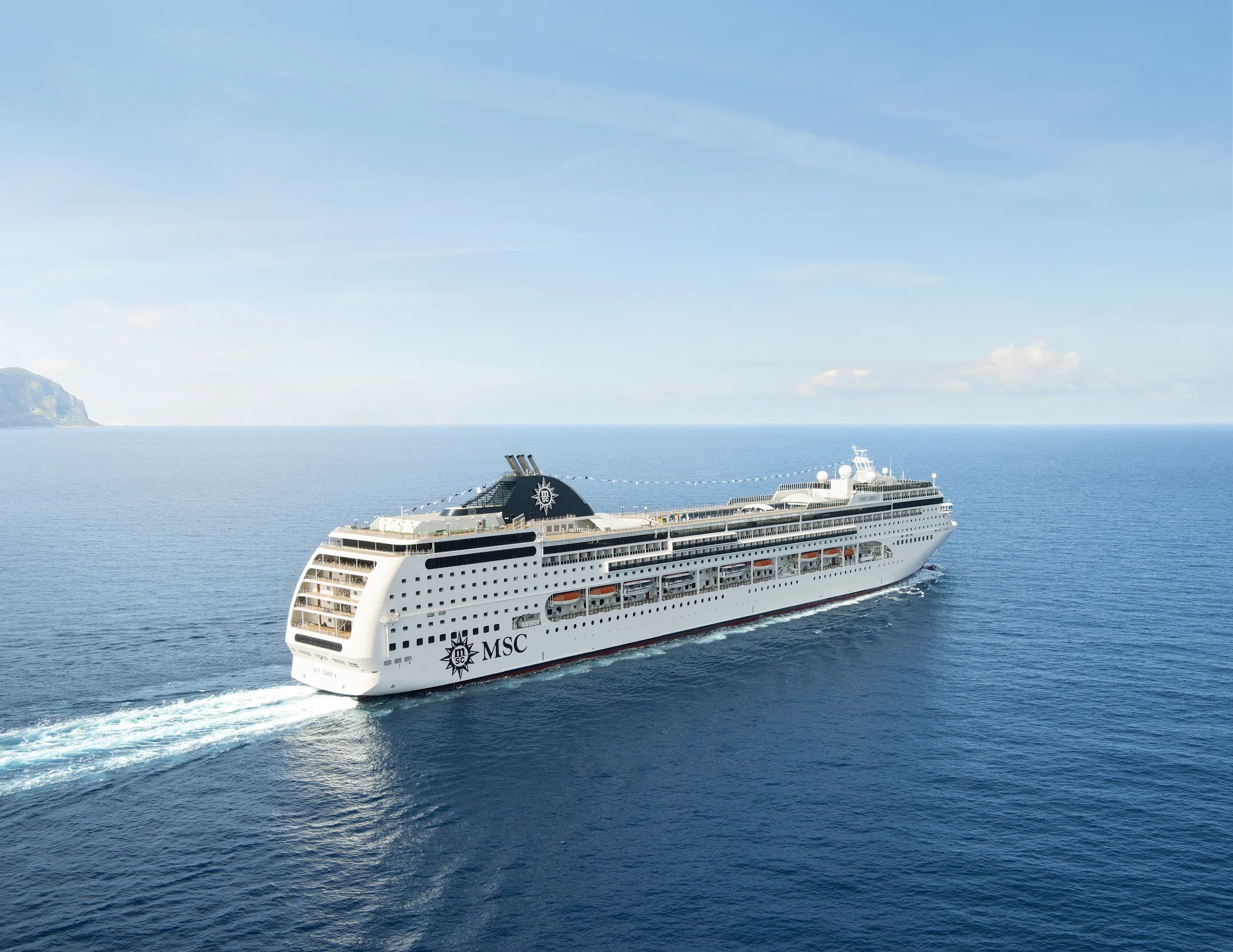
The MSC Lirica Class represents a very different style of cruising from the giant ships that now dominate much of the MSC Cruises fleet.
These are MSC’s smallest current ships.
While newer vessels like MSC World America carry more than 6,000 passengers at maximum capacity, the four Lirica Class ships carry roughly 2,600 guests.
That difference affects almost everything about the experience.
There are fewer restaurants, fewer bars, fewer pools and far fewer headline attractions.
There is no giant indoor promenade.

There is no MSC Yacht Club.
And there are no sprawling entertainment districts or massive waterparks.
Instead, the Lirica Class focuses on traditional cruising: destination-heavy itineraries, main dining rooms, buffets, lounges, live music, theater shows, outdoor pools, kids clubs, spa facilities and ships that are relatively easy to navigate.
For travelers who think today’s biggest cruise ships can simply be too much, the Lirica Class offers something increasingly unusual.
The class includes four ships:
| Ship | Joined MSC | Gross Tonnage | Maximum Guests | Staterooms |
|---|---|---|---|---|
| MSC Lirica | 2003 | 65,591 GT | 2,648 | 988 |
| MSC Opera | 2004 | 65,591 GT | 2,658 | 1,070 |
| MSC Armonia | 2004 | 65,542 GT | 2,620 | 974 |
| MSC Sinfonia | 2005 | 65,591 GT | 2,646 | 976 |
MSC officially identifies these four vessels as the Lirica Class and describes their smaller size as an advantage for reaching ports that larger ships may not be able to access as easily.
Quick Answer: What Is the MSC Lirica Class Known For?
MSC Lirica Class ships are best known for their smaller size, simple layouts, traditional cruise atmosphere and port-focused itineraries.
These ships work especially well for travelers who care more about where the cruise is going than having a huge attraction list onboard.
The class is also unusual because all four ships underwent MSC’s Renaissance Program between 2014 and 2015.
MSC physically lengthened each vessel by inserting a new 24-meter section into the middle of the ship, adding cabins, family spaces, dining capacity and other amenities.
If you want MSC Yacht Club, dozens of restaurants and giant waterparks, this is not the class to choose.
If you want a smaller MSC ship that is easy to get around and well suited to destination-heavy cruising, the Lirica Class deserves a look.
Is the Lirica Class the Same as the Mistral Class?
This is where MSC fleet history gets a little confusing.
You may see Armonia, Sinfonia, Lirica and Opera described online as Mistral Class ships.
Historically, that is understandable.
The design traces back to Mistral, a cruise ship built for Festival Cruises in 1999. Festival later introduced two enlarged ships based on that design: European Vision in 2001 and European Stars in 2002.
European Vision eventually became MSC Armonia.
European Stars became MSC Sinfonia.
MSC then built Lirica and Opera using the same broader design family.
The original Mistral never became an MSC ship and eventually changed operators and names several times.
So, technically, you can trace all five ships back to the broader Mistral design.
But for an MSC-focused guide, Lirica Class is the better name.
MSC itself currently groups Armonia, Sinfonia, Opera and Lirica together as the Lirica Class.
What Makes the MSC Lirica Class Different?
The biggest thing that separates the Lirica Class from the rest of the MSC fleet is size.
These ships are around 65,500 gross tons.
Compare that with:
- Musica Class: roughly 92,000 to 95,000 GT
- Fantasia Class: roughly 138,000 to 139,000 GT
- Seaside EVO Class: around 170,000 GT
- World Class: more than 215,000 GT
That makes the Lirica ships dramatically smaller than MSC’s newest vessels.
You notice the difference quickly.
Walking from one end of the ship to the other takes less time.
Public rooms are closer together.
It is easier to remember where the theater, dining room and pool are located.
And you do not need several days to understand the basic layout.
The tradeoff is variety.
There are fewer restaurants, fewer bars and lounges, fewer pools and fewer attractions.
The Lirica Class works best when you view the ship as part of the vacation rather than the entire vacation.
That makes these vessels particularly well suited to Europe, the Caribbean and other itineraries where passengers spend a lot of time exploring ports.
The Renaissance Program
The biggest chapter in the modern history of the Lirica Class came between 2014 and 2015.
MSC launched a roughly €200 million Renaissance Program to enlarge and modernize all four ships.
This was not a normal refurbishment.
Fincantieri engineers physically cut each ship into two sections and inserted a new 24-meter midship section.
The work increased the ships from about 251 meters to roughly 275 meters long.
MSC also added approximately 193 passenger cabins to each ship along with new crew accommodations and expanded public areas.
The refurbishment schedule was:
- MSC Armonia – 2014
- MSC Sinfonia – early 2015
- MSC Opera – summer 2015
- MSC Lirica – late 2015
MSC Armonia was the first ship to undergo the transformation.
MSC Lirica completed the program later in 2015.
The program also introduced or expanded:
- Balcony cabins
- Baby Clubs
- Mini Clubs
- Young Clubs
- Teen Clubs
- Spray Parks
- Buffet capacity
- Main dining space
- Lounges
- MSC Aurea Spa facilities
- Libraries
- Other public areas
The result is that today’s Lirica Class ships are significantly larger and more capable than the vessels originally delivered in the early 2000s.
MSC Lirica
MSC Lirica is the namesake of the class and entered the MSC fleet in 2003.
She currently measures 65,591 gross tons and carries up to 2,648 passengers in 988 staterooms.
Lirica has a traditional layout with dining rooms, bars, lounges and entertainment concentrated on the lower decks, passenger cabins through the middle of the ship and pools, buffet dining, spa, fitness and kids spaces higher up.
One thing that helps Lirica stand out within the class is dining.
MSC currently lists Kaito Sushi Bar aboard the ship, giving Lirica a dedicated specialty-dining option in addition to the main dining rooms and casual dining venues.
Cabins range from interior and ocean-view accommodations to balcony cabins and Junior Suite Aurea rooms.
Balcony inventory is much more limited than aboard newer MSC ships, which reflects the era when Lirica was originally designed.
If you want to dig deeper into the ship itself, see our MSC Lirica ship guide.
MSC Opera
MSC Opera joined the fleet in 2004 and is one of the larger-capacity ships in the class despite sharing nearly identical overall dimensions with Lirica and Sinfonia.
MSC currently lists Opera at 65,591 gross tons with capacity for 2,658 passengers, 1,070 staterooms and 728 crew members.
Opera follows the familiar Lirica Class formula:
- Main dining rooms
- Buffet
- Traditional bars and lounges
- Theater
- Casino
- Outdoor pools
- Kids clubs
- Spa
- Fitness center
- Limited balcony accommodations
Opera also has some larger Aurea balcony categories than several of her sisters, including Junior Suite Aurea and Deluxe Balcony Aurea accommodations.
Her itinerary schedule is also becoming particularly interesting.
Beginning in November 2026, MSC Opera moves into the Southern Caribbean with cruises from La Romana in the Dominican Republic.
MSC is using Opera for seven-night itineraries along with 14-night back-to-back combinations visiting destinations across the Lesser Antilles and Virgin Islands.
The deployment continues through summer 2027, giving the Lirica Class a rare year-round Caribbean presence.
MSC Armonia
MSC Armonia joined MSC in 2004 after originally sailing as European Vision for Festival Cruises.
She currently measures 65,542 gross tons and carries up to 2,620 passengers in 974 staterooms.
Armonia was the first ship to undergo MSC’s Renaissance Program.
In 2014, engineers inserted the 24-meter midship section that became the blueprint for the remainder of the class.
The ship offers a particularly traditional MSC experience with venues such as:
- Marco Polo
- La Brasserie
- Il Girasole
- The White Lion Pub
- Caffè San Marco
- The Red Bar
Armonia also has the family spaces and Spray Park added during the Renaissance Program.
Her smaller size makes her particularly well suited to destination-heavy Mediterranean itineraries and longer cruises where the ports are the main attraction.
Read our complete MSC Armonia guide for cabins, dining, pools and itinerary details.
MSC Sinfonia
MSC Sinfonia is another ship with roots outside MSC.
She originally sailed as European Stars for Festival Cruises before joining MSC and becoming Sinfonia.
The ship currently measures 65,591 gross tons with capacity for up to 2,646 passengers and 976 staterooms.
Sinfonia has one of the stronger music-inspired identities in the class.
Venues include:
- Teatro San Carlo
- Manhattan Bar
- Café Le Baroque
- Pasha Club
- Sinfonia Lounge
- Shelagh’s House Irish Pub
Like Armonia, Sinfonia underwent her Renaissance enlargement in 2015.
MSC added a 24-meter section containing 193 new cabins along with additional family spaces, dining capacity and a Spray Park.
Sinfonia is particularly well suited to Mediterranean cruising, where passengers can spend the day exploring ports and return to a smaller, straightforward ship in the evening.
Read our complete MSC Sinfonia guide for more details.
Cabins on MSC Lirica Class Ships
Cabins across the Lirica Class are simpler than those aboard MSC’s newest vessels.
Typical categories include:
- Interior
- Ocean view
- Obstructed ocean view
- Balcony
- Junior Suite Aurea
There is no MSC Yacht Club on any Lirica Class ship.
That is one of the biggest differences between Lirica Class and the newly refurbished Musica Class.
The Lirica ships were also designed when balcony cabins were far less common than they are today.
As a result, ocean-view cabins make up a much larger portion of the inventory.
Balcony rooms exist, particularly after the Renaissance Program, but they can be limited.
Typical standard cabins are roughly 130 to 140 square feet.
Premium Ocean View cabins can reach approximately 237 square feet.
Junior Suite Aurea cabins generally provide around 237 to 248 square feet plus a balcony of roughly 54 square feet depending on the ship.
If you absolutely want a balcony, book earlier than you might aboard a newer MSC ship.
Dining on Lirica Class Ships
Dining is considerably simpler than on larger MSC vessels.
The experience is generally centered around:
- Main dining rooms
- Buffet dining
- Pizza
- Casual pool-deck food
- Room service
There are far fewer specialty restaurants.
MSC Lirica is currently the most notable exception because MSC lists Kaito Sushi Bar onboard.
For the rest of the class, you should expect the main dining room and buffet to handle most meals.
That is not necessarily a problem on a port-intensive cruise.
If you are ashore most days and only need breakfast, dinner and a few casual meals aboard the ship, the simpler setup may be perfectly adequate.
Our MSC Dining Guide explains included food across the fleet.
You can also read our MSC Buffet Guide for typical hours, food choices and included drinks.
Bars and Lounges
Traditional bars and lounges are one area where the Lirica Class still has plenty of character.
These ships were designed before giant promenades became the centerpiece of modern cruise ships.
Instead of concentrating nightlife in one central zone, the Lirica ships have smaller individual venues spread throughout the lower public decks.
Depending on the ship, you may find:
- Pubs
- Coffee bars
- Piano bars
- Casino bars
- Pool bars
- Dance lounges
- Discos
- Libraries
- Cigar lounges
The names vary from ship to ship.
The overall experience is similar.
A lounge might be quiet during the afternoon, offer live music before dinner and become a more active entertainment space later in the evening.
If you plan to spend time at the bars, our MSC Drink Packages Guide explains the current package options.
Entertainment on Lirica Class Ships
Entertainment follows a traditional cruise format.
Every ship has a main theater used for production shows and other performances.
You can also expect activities such as:
- Live music
- Dancing
- Trivia
- Karaoke
- Casino gaming
- Theme parties
- Pool games
- Organized competitions
- Video games
- Discos
What you will not find is just as important.
There are no bumper cars.
There are no giant ropes courses.
There are no huge multi-deck entertainment arenas.
There are no World Class-style districts.
The Lirica Class is much more about dinner, a show, drinks and live music.
Pools and Outdoor Spaces
Pool areas are relatively simple across the class.
Expect traditional open-air swimming pools with:
- Whirlpools
- Sun loungers
- Pool bars
- Casual food nearby
- Organized activities
The Renaissance Program also added children’s Spray Parks to help modernize the family experience.
There are no large aft infinity pools like those found on newer ships.
There are no giant covered pool complexes.
There is no private Yacht Club pool.
For warm-weather itineraries, the straightforward pool decks work well.
Family Activities and Kids Clubs
Family facilities were one of the biggest focuses of MSC’s Renaissance Program.
MSC added or upgraded age-specific areas including:
- Baby Club
- Mini Club
- Junior Club
- Young Club
- Teen Club
- Spray Park
- Video games
- Family activities
MSC also worked with partners such as Chicco and LEGO on the redesigned kids spaces.
Families should still set expectations appropriately.
These ships do not have the giant waterparks or attraction districts found aboard MSC World America, Seashore or Seascape.
They work better for families who plan to spend much of the day exploring destinations.
Our MSC Cruises With Kids Guide covers the broader family experience.
MSC Aurea Spa and Fitness
All four ships offer MSC Aurea Spa facilities and fitness centers.
The Renaissance Program expanded the spa areas and added additional wellness space.
You can generally expect:
- Massage treatments
- Beauty services
- Sauna and steam facilities
- Salon services
- Gym equipment
- Outdoor walking areas
The gyms are smaller than those aboard newer ships but are adequate for a typical cruise workout.
The class also has relatively straightforward outdoor walking routes.
Our MSC Running and Walking Tracks Guide covers the outdoor loops across MSC ships.
Where Do Lirica Class Ships Sail?
The Lirica Class is heavily destination-focused, and MSC uses these smaller ships across several regions.
Current and upcoming deployments include:
- Mediterranean
- Southern Caribbean
- South Africa
- Indian Ocean routes
- MSC Grand Voyages
MSC Opera is particularly notable because she begins year-round Southern Caribbean cruising from late 2026, including departures from La Romana and later Fort-de-France.
Armonia, Sinfonia and Lirica continue to feature heavily in Mediterranean deployments.
This is where the smaller ship size becomes especially useful.
MSC specifically notes that Lirica Class ships can reach destinations that may be less practical for larger vessels.
For these ships, itinerary should often be the first reason you book.
Lirica Class vs. Musica Class
The difference between Lirica Class and Musica Class is significant.
| Feature | Lirica Class | Musica Class |
|---|---|---|
| Size | About 65,500 GT | About 92,000 to 95,000 GT |
| Maximum guests | About 2,600 | About 3,200 |
| Yacht Club | No | Yes after current upgrades |
| Balcony availability | Limited | Much better |
| Specialty dining | Limited | Butcher’s Cut and Kaito on upgraded ships |
| Ship feel | Small and traditional | Mid-sized and traditional |
| Best for | Destination-focused cruising | More onboard variety without mega-ship size |
The MSC Musica Class is probably the logical next step for someone who likes the idea of a smaller MSC ship but wants more restaurants, more balcony cabins and MSC Yacht Club.
The Lirica Class wins on simplicity and size.
The Musica Class wins on amenities.
Lirica Class vs. Fantasia Class
The Fantasia Class represents another major step up.
Fantasia Class ships are roughly twice the gross tonnage of the Lirica ships.
They add:
- MSC Yacht Club
- More specialty dining
- More pools
- Larger theaters
- More family activities
- Larger casinos
- More bars and lounges
- More balcony cabins
The tradeoff is more passengers and more walking.
Choose Lirica Class if smaller size is a priority.
Choose Fantasia Class if you want a more resort-like ship but still prefer something more traditional than MSC’s newest vessels.
Lirica Class vs. MSC’s Newest Ships
The gap becomes enormous when comparing Lirica Class with World, Seaside or Meraviglia Class ships.
Newer MSC ships can offer:
- Giant indoor promenades
- Neighborhood-style districts
- Waterparks
- Large kids areas
- Multiple specialty restaurants
- Extensive outdoor spaces
- High-tech entertainment
- MSC Yacht Club
- Several pool environments
The Lirica Class offers:
- Main dining
- Buffet dining
- Pools
- Theater
- Casino
- Bars and lounges
- Kids clubs
- Spa
- Gym
- Traditional entertainment
Neither approach is automatically better.
They are simply different vacations.
Pros and Cons of the MSC Lirica Class
The biggest advantage is size.
These are easy ships to navigate.
They carry fewer passengers than almost anything else in the MSC fleet.
And they are particularly well suited to itineraries where the ports are the reason for the vacation.
The Renaissance Program also gave the ships a significant second life by adding cabins, family areas and additional public space.
The biggest disadvantage is variety.
There are fewer restaurants.
Balcony cabins are limited.
There is no MSC Yacht Club.
There are fewer attractions for families.
And passengers who enjoy exploring a huge resort-style ship may run out of new things to discover fairly quickly.
Who Should Sail on an MSC Lirica Class Ship?
The Lirica Class is a strong fit for:
- Cruisers who prefer smaller ships
- Travelers who dislike mega ships
- Couples who enjoy traditional cruise entertainment
- Passengers who prioritize itinerary over attractions
- Mediterranean cruise travelers
- Southern Caribbean passengers considering MSC Opera
- Families who want kids clubs but not giant waterparks
- Travelers who value short walks and easy navigation
- Cruisers comfortable with a simpler dining lineup
- Passengers who enjoy lounges, live music and traditional evenings at sea
The class may not be the best fit for:
- Yacht Club fans
- Cruisers who want lots of specialty dining
- Passengers who insist on a balcony
- Families looking for major waterparks
- Travelers who want the newest MSC technology
- Cruisers who consider the ship itself the main destination
Final Thoughts on the MSC Lirica Class
The MSC Lirica Class may be the least flashy part of the MSC fleet.
That is also exactly why it remains interesting.
Cruise ships keep getting larger.
MSC World Class ships now exceed 215,000 gross tons.
The Lirica ships are barely over 65,000.
They carry roughly 2,600 passengers instead of 6,000-plus.
They do not have giant promenades, neighborhoods or endless lists of restaurants.
And they do not have MSC Yacht Club.
But smaller does not automatically mean worse.
These ships are easy to learn.
They are easy to walk around.
They still provide pools, restaurants, bars, theaters, casinos, kids clubs, spa facilities and entertainment.
And their size allows MSC to use them on destination-focused itineraries where the ship does not need to be the star of the vacation.
The Renaissance Program also means the ships are more capable than their age alone suggests.
MSC physically lengthened all four ships and added hundreds of new accommodations and public-space improvements across the class.
The result is something increasingly rare in modern cruising: a genuine small-ship option from a large mainstream cruise line.
If your ideal cruise involves spending the day exploring Greece, Italy, Croatia, the Caribbean or another destination and returning to a comfortable, straightforward ship at night, the MSC Lirica Class could be a very good fit.
If your ideal cruise involves spending seven days trying to experience everything aboard a giant floating resort, you should probably look elsewhere in the MSC fleet.
That difference is exactly what makes the Lirica Class worth keeping around.