
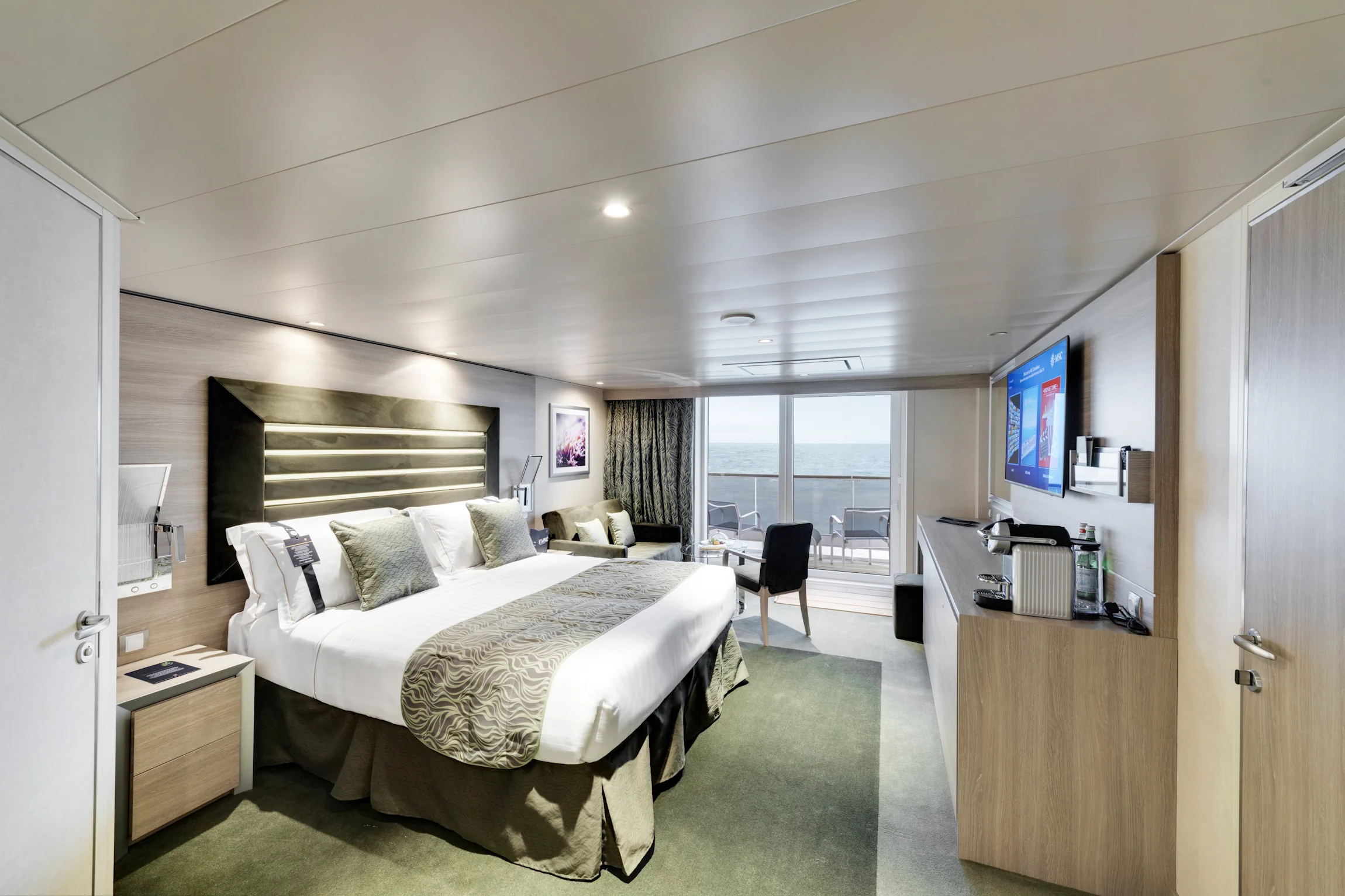
If you or someone in your travel party needs an accessible cabin on an MSC cruise, the good news is that MSC does offer accessible staterooms across the fleet. The challenge is that these cabins are limited, they can vary from ship to ship, and some of the most important details are not always obvious unless you dig into deck plan legends, cabin notes, and the cruise line’s accessibility information.
That is why accessible cabins are one of those MSC topics where booking early really matters. It also helps to understand what these rooms generally look like, what makes them different from a standard cabin, and which details you should double-check before you commit. MSC encourages guests with disabilities or reduced mobility to contact the company in advance of booking to determine the specifications of cabins, vessel facilities, and embarkation and disembarkation arrangements.
To read more on MSC cabins, check out our accomodations guide.
What accessible cabins on MSC generally look like
Compared with a standard cabin, MSC accessible cabins are designed to be easier to navigate for guests with disabilities or reduced mobility. MSC says these cabins are designed with wider entrance doors, lower shelves, spacious wet-room-style bathrooms, handrails, and ramps for easier balcony access where applicable. In real-world terms, that usually means more maneuvering space and a layout that is designed to reduce some of the tight turns and narrow pinch points that standard cabins can have.
On later-generation ships, cruisers may also find additional accessibility touches beyond just extra floor space. MSC says guests with visual impairments will find braille signs at cabin entrances, and that most onboard elevator signs are in braille, with audio call signals on ships of the last generation. For guests with hearing disabilities, MSC says cabins are equipped with a TDD/TTY system kit that typically includes light and vibrating devices, a text phone for Guest Services communication, and an alarm clock.
At the same time, MSC does not publish one simple fleet-wide spec sheet with exact measurements for every accessible cabin across every ship. So while later ships may include more advanced accessibility features, it is still smartest to treat exact room details as ship-specific.
The bathroom is usually the biggest difference
If there is one area where accessible cabins stand apart most clearly, it is the bathroom. MSC describes accessible cabins as having spacious wet-room-style bathrooms, which is a major difference from the tighter, more compact bathroom layout found in most standard cabins.
On newer ships, there may also be more support-oriented features in and around the bathroom area, such as grab bars and layouts designed for easier use with mobility devices. MSC also says that a shower stool can be requested in a standard cabin, which is helpful context for cruisers who may need some support but do not necessarily need a full accessible cabin.
Accessible balcony cabins can be much more usable
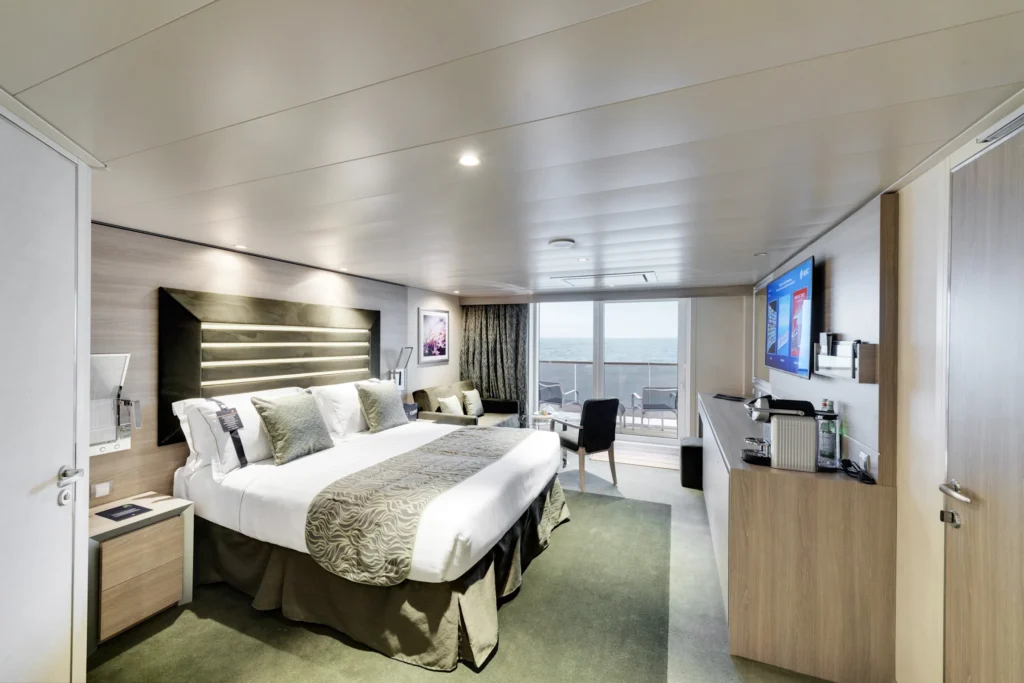
If you are looking at an accessible balcony cabin, one of the most helpful MSC details is that the line specifically mentions ramps for easier balcony access. On a regular balcony cabin, the threshold can be a nuisance. On an accessible balcony cabin, MSC is telling you that the transition is designed to be smoother and easier to manage.
That may sound like a small detail, but for many cruisers it can be the difference between having a balcony in theory and actually being able to enjoy it comfortably during the cruise.
You still get the core cabin features
An accessible MSC cabin is not a stripped-down room. You are still generally getting the main basics of the category you booked, such as a TV, safe, hairdryer, minibar, and the usual core stateroom setup. MSC’s ship pages also note that accessible cabins are included within the broader cabin categories, and that the size, layout, and furniture may vary within the same category.
That is an important point because the main difference is usually the room’s usability and layout, not the removal of standard features.
Accessible cabins are often larger, but not always arranged like standard rooms
One of the easiest assumptions to make is that an accessible cabin is just a standard room with more square footage. In practice, it is often more than that. MSC notes on ship pages like MSC Meraviglia that accessible cabins are larger, but it also warns that layout and furniture can vary within the same cabin category.
That means the bed configuration can be different too. On some ships, accessible cabins may not have the same flexibility as a standard room when it comes to converting beds. This is the kind of detail that matters a lot and is worth verifying before you book, especially if two guests are sharing the room and bed setup is important.
How to find accessible cabins on MSC deck plans
MSC deck plans do include accessibility notations, but they are not always front-and-center unless you check the legend. On ships like MSC Seaview and MSC Meraviglia, MSC’s deck plans include legend items for both “Cabins for guests with disabilities or reduced mobility” and “Ambulatory Accessible Cabins.” That tells you two things: the symbols do exist, and there may be more than one accessibility-related cabin type on a ship.
So when you are looking through a deck plan, do not just focus on cabin numbers. Open the legend, look for the accessibility markers, and then read the cabin notes carefully. MSC also notes that ship configuration, data, and cabin descriptions may vary, so the deck plan should be treated as a guide rather than the whole story.
How to book an accessible cabin on MSC
This is not a booking situation where it makes sense to wait and sort things out later. MSC says that guests who require an accessible cabin, or who need to bring mobility aids or medical equipment, should provide full details in writing at the time of booking and no less than 30 days prior to embarkation. MSC also requires guests needing medical equipment to complete the online Accessibility & Medical Request Form at least 30 days before sailing.
During the booking process, look for MSC’s accessibility options and be ready to complete the accessibility form with the details of what you need. This is where you would communicate things like mobility devices, oxygen equipment, service dog arrangements, or other special accommodation needs.
Bringing a wheelchair or scooter? Check the rules first
MSC allows guests to bring manual or electric wheelchairs and scooters, but there are important limits to know. The cruise line says these devices must be stored inside the cabin, not in hallways. If you are bringing an electric wheelchair or scooter, MSC says you must specify whether it uses a gel, dry, or lithium battery. Wet batteries are not permitted onboard.
MSC also says you should confirm the dimensions of your specific ship to make sure your mobility device can comfortably navigate through the cabin door. On its U.S. accessibility page, MSC notes that standard cabin entry widths can be limited, and on some ships doorways can be as narrow as 23 to 27 inches. The company’s Conditions of Carriage also says doorways can be as narrow as 26 inches depending on the ship.
That is one reason MSC is very direct about who should book an accessible cabin. The line says that if you choose a standard cabin, you are acknowledging that you can stand briefly, take steps without a mobility device, and access the bathroom area without additional supports. It also states that a guest who primarily uses a wheelchair or scooter should verify size restrictions carefully and book an accessible cabin if needed.
Can a non-disabled guest book one just because it is bigger?
This is not a great strategy. MSC says that if an accessible cabin is booked by a guest who does not require it, that guest may be moved at any time to a non-accessible stateroom. In other words, these cabins are meant for guests who actually need them, not for cruisers looking for extra floor space.
That is worth keeping in mind because accessible rooms can look appealing on paper, especially when they appear larger than standard cabins in the same category. But on MSC, they are not really a cabin hack.
A few things to verify before you book
Before booking an accessible cabin on MSC, it is smart to confirm the exact ship, the exact cabin type, the bed setup, whether a balcony ramp matters for your needs, and whether your mobility device will comfortably fit the doorway and room. MSC specifically encourages guests with disabilities or reduced mobility to contact the company in advance of booking to determine cabin specifications and port-related accessibility details.
It is also worth looking at the itinerary. MSC notes that tender ports can be more challenging because guests must be able to board and disembark the tender safely, and crew members are not permitted to carry wheelchairs or mobility scooters into the tender.
Final thoughts
Accessible cabins on MSC Cruises can be a very good fit for cruisers who need them, but they are one of those cabin topics where the details matter much more than a quick brochure summary. Across the fleet, you can generally expect a more open layout, a more usable bathroom, better support features, and easier access than you would get in a standard room. But the exact layout, equipment, and configuration can still vary by ship and sometimes by cabin category.
The smartest move is to reserve early, verify carefully, and match the room to your actual needs instead of assuming all accessible cabins are interchangeable. On MSC, that extra step can make a big difference in how comfortable your cruise feels once you are onboard.