
Cruising with dietary restrictions can feel a little intimidating.
At home, you know your favorite restaurants. You know which grocery stores carry your safe foods. You know which coffee shop has oat milk and which one looks at you like you asked for moon water.
On a cruise ship, it is different. You are eating in main dining rooms, buffets, specialty restaurants, private islands, poolside grills, and sometimes random snack counters where the line is moving fast and the menu board is not exactly writing a novel.
The good news is that MSC Cruises can be a very workable cruise line for vegetarian, vegan, gluten-free, and allergy-sensitive guests. MSC officially says vegetarian and vegan-friendly dishes are incorporated into both its main restaurant menus and buffet restaurant offerings. MSC also says it can accommodate most special dietary requirements in the main restaurants, where there is more control over how special meals are prepared and served.
The important part is knowing where MSC is strongest, where you need to plan ahead, and where you should be more careful.
For most guests with serious dietary needs, the main dining room is going to be the safest and most reliable place to eat. The buffet can be convenient and useful, especially for vegetarians and many vegan guests, but it is not the best place to manage severe allergies or celiac-level gluten concerns. Ocean Cay is beautiful, but it is also less flexible for special orders and allergy management than the ship.
Here is what to know before you sail.
The Most Important Step: Tell MSC Before You Sail
If you have a serious allergy, gluten sensitivity, celiac disease, or another specific dietary requirement, do not wait until dinner on the first night to bring it up.
MSC advises guests with allergies or intolerances to inform the cruise line at the time of booking, but no later than 30 days before sailing, by using the Accessibility and Medical Requests Form. MSC also asks guests to report their special diet needs once onboard to Guest Services and the maître d’hôtel in the main dining room before consuming food or beverages onboard.
You can find the special request form here.
That may sound like overkill, but it is not.
Think of it this way: the form helps MSC prepare before you arrive, while the onboard conversation helps make sure the people actually serving your meals know what you need.
For guests with severe allergies, this step is not just a formality. It is the foundation of the whole dining strategy.
MSCCruiseFan Tip: Do not assume your dietary request automatically made it from the booking system to your actual dining team. Confirm it in person once onboard.
Why the Main Dining Room Matters Most
The main dining room is where MSC has the most control over special dietary meals.
MSC specifically says its main dining rooms are best equipped to handle special dietary requests and reduce the unintentional risk of cross-contamination. The cruise line strongly advises guests with allergies to eat in the main dining rooms, where the dining staff can better assist.
That is the key point for this entire topic.
The buffet might be faster. The buffet might be easier. The buffet might have more visible choices. But for serious allergies, gluten-free dining, or more complex dietary restrictions, the main dining room is usually the better option.
This is also where you can build a relationship with your serving team. Your waiter, assistant waiter, head waiter, and maître d’ can help guide you through the menu, answer questions, and in some cases help you review meals in advance.
For guests with serious allergies, that next-day planning can be extremely helpful. Many guests work with the head waiter to review the following day’s menu ahead of time so the kitchen has more time to prepare a safe meal instead of trying to solve everything during the dinner rush.
That is much better than sitting there hungry while everyone else is halfway through dessert.
Vegetarian Dining on MSC Cruises
Vegetarian guests should generally have the easiest time dining on MSC.
That does not mean every meal will be life-changing, but vegetarian options are usually not hard to find. MSC’s Italian and Mediterranean influence helps here. Pasta, risotto, eggplant dishes, salads, soups, vegetables, breads, cheeses, and pizza-style options tend to show up across the ship.
In the main dining room, vegetarian options are commonly marked on the menu, making it easier to spot meat-free dishes without interrogating your waiter like you are cross-examining a witness.
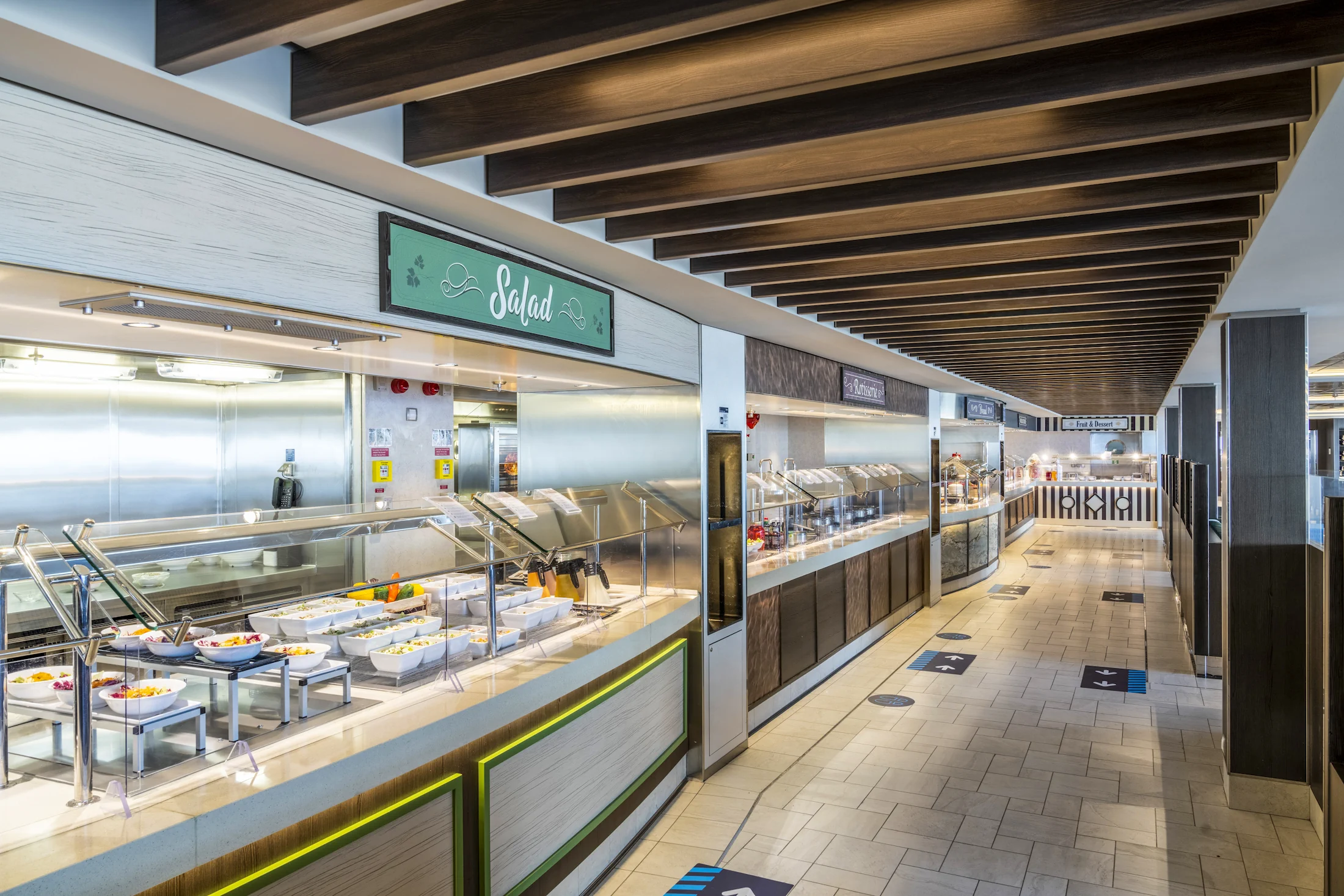
The buffet is also usually pretty workable for vegetarians. You can often build a solid plate from salads, vegetables, pasta, potatoes, rice, fruit, breads, breakfast items, pizza, and international dishes.
For vegetarians, the bigger issue is usually not whether you can find food. It is whether the options feel varied enough across a full cruise.
A few practical tips:
- Check the full menu before deciding there is “nothing”
- Look at pasta, risotto, soup, and appetizer sections
- Ask the dining team if a dish can be made vegetarian
- Do not overlook the buffet’s ethnic or wellness sections
- For specialty dining, look for vegetarian symbols or highlighted vegetarian items on the menu
Overall, vegetarian dining on MSC should be very manageable.
Vegan Dining on MSC Cruises
Vegan dining on MSC takes a little more attention than vegetarian dining, but it is very doable.
In the main dining room, MSC typically features at least one dedicated vegan starter, entree, and dessert each night. That is important because vegan guests are not always stuck trying to create a meal from side dishes or asking the kitchen to remove cheese from something that was never really meant to be vegan in the first place.
That makes the main dining room the best home base for vegan dinners.
A good vegan dining strategy on MSC looks something like this:
- Submit dietary needs before sailing if needed
- Talk to the dining team on embarkation day
- Ask if vegan items are marked or available on the menu
- Confirm whether vegan desserts are available each night
- Ask about plant-based milk options early in the cruise
- Use the buffet for flexibility, but the MDR for more complete meals
The main dining room is especially useful because vegan meals are more likely to feel like complete dinners there. You are more likely to get a proper starter, entree, and dessert rather than a plate of “well, here are some vegetables and rice, good luck.”
And yes, anyone who has ever tried to eat vegan while traveling knows exactly what that plate looks like.
Vegan Options in the Buffet
All MSC buffets should have vegan options, but the setup can vary by ship.
On newer and larger MSC ships, the buffet may have a dedicated vegan-friendly section or a more clearly marked plant-based area. This can be a helpful spot for breakfast, lunch, or casual meals.
One of the better buffet strategies is to look beyond the obvious salad bar. MSC buffets often have ethnic and international sections, and those areas can be especially useful for vegan guests. Indian-style dishes such as dal, vegetable curries, basmati rice, and stewed vegetables can be some of the best vegan-friendly options onboard.
That said, the buffet can get repetitive on longer cruises. Vegan desserts in the buffet may also be limited, often leaning toward fruit or sorbet. For a more complete vegan dessert, the main dining room is usually the better bet.
Also, be careful with hidden ingredients. Butter, cheese, cream, eggs, fish sauce, chicken stock, and honey can all sneak into dishes that look plant-based at first glance.
When in doubt, ask.
Plant-Based Milk on MSC
Plant-based milk is available on MSC, but availability can vary by ship, bar, venue, and sailing.
Soy or almond milk may be available at coffee-focused venues, some bars, buffet areas, or main dining spaces, but I would not build your entire morning happiness around one specific plant milk being available at one specific counter.
The best move is to ask early in the cruise.
If your ship has a dedicated coffee venue, start there. You can also ask at the buffet, main dining room, or Yacht Club team if you are sailing Yacht Club.
This is one of those small cruise details that matters more than people realize. Nobody wants to start vacation day two with bad coffee and dietary confusion. That is not the dream.
Gluten-Free Dining on MSC Cruises
MSC has a more structured gluten-free dining setup than many first-time guests might expect.
MSC says it offers meals with gluten-free ingredients for breakfast, lunch, and dinner in the main restaurants on most of its ships. MSC also says these meals are prepared by skilled personnel in dedicated kitchens onboard.
For the main dining room, MSC uses a separate galley or kitchen area for gluten-free preparation on most ships. This is one of the biggest reasons gluten-free guests should lean heavily on the MDR instead of trying to manage everything at the buffet.
MSC also notes that gluten-free meals are available in the main restaurants only.
There is one important caveat: MSC Armonia, MSC Sinfonia, MSC Opera, and MSC Lirica have a more limited gluten-free offering. MSC says guests on those ships will find a limited selection of pre-packaged gluten-free snacks such as biscuits, croissants, sponge cakes, and muffins.
So if gluten-free dining is a major concern, the ship itself matters.
A gluten-free guest on MSC should:
- Submit the special needs request before sailing
- Visit the main dining room team on embarkation day
- Ask about gluten-free menus for breakfast, lunch, and dinner
- Confirm where gluten-free bread, pasta, and desserts are available
- Be cautious with the buffet
- Avoid assuming “gluten-free ingredient” means zero cross-contact risk everywhere onboard
MSC does say it has robust preventive measures, but it also says the risk of accidental allergen cross-contamination cannot be completely ruled out due to limited space on the ship.
That is an honest and important distinction.
Food Allergies on MSC Cruises
Food allergies are where you should be the most careful.
MSC recognizes a range of major allergens, including gluten, soybeans, peanuts, tree nuts, sesame, crustaceans, fish, mollusks, dairy products, egg, mustard, celery, sulphites, and sulphur dioxide. Guests with allergies are advised to inform MSC before sailing and confirm their needs onboard.
For guests with serious allergies, the main dining room should be the default dining location whenever possible.
The buffet is simply harder to control. Even if the kitchen prepares something safely, the buffet environment adds other risks:
- Shared serving utensils
- Guests moving utensils between dishes
- Unclear sauces or toppings
- Crumbs and spills
- Nearby allergens
- Staff who may not know every ingredient offhand
- Fast-moving lines where detailed questions are harder
MSC specifically says it cannot guarantee no cross-contamination at the buffet.
That does not mean allergy-sensitive guests can never use the buffet. But if you have a severe allergy, the buffet is not where I would want to play ingredient detective.
A better allergy strategy:
- Submit the request form at least 30 days before sailing
- Bring written notes listing your allergies
- Meet with the maître d’ on embarkation day
- Ask whether meals can be reviewed in advance
- Stick with the main dining room when possible
- Carry prescribed emergency medications as directed by your doctor
- Be extra cautious with desserts, sauces, fried foods, and buffet items
MSC also advises guests with allergies or intolerances to carry prescribed emergency medications so they can respond effectively in the event of an allergic reaction.
Main Dining Room vs. Buffet: Which Is Better?
Here is the simple version.
The main dining room is better for:
- Severe allergies
- Gluten-free dining
- Vegan dinners
- Special meal planning
- Ingredient questions
- Consistent communication with dining staff
The buffet is better for:
- Quick meals
- Casual vegetarian options
- Fruit, salads, vegetables, rice, and simple sides
- Flexible breakfast or lunch
- Vegan guests who know what to look for
- Lower-risk dietary preferences
The buffet is not bad. It is just less controlled.
For vegetarians, it can be perfectly fine. For vegans, it can be useful but uneven. For gluten-free guests or anyone with a severe allergy, the MDR is usually the safer choice.
Specialty Restaurants: Vegan, Vegetarian, and Allergy-Friendly Options
MSC specialty restaurants can work for vegetarian and vegan guests, but you should review menus before booking.
The good news is that specialty restaurant menus typically highlight vegan and vegetarian items. That makes it easier to evaluate whether a restaurant is worth the extra cost before you commit.
Some venues are naturally easier than others.
Hola! Tacos can be a solid option for vegetarians because tacos, guacamole, salsa, beans, rice, and vegetable-based dishes are easier to work with. Indochine can also be a better fit for some plant-based diners because Asian-inspired menus often include vegetable-forward starters and dishes.
Butcher’s Cut is more complicated. Vegetarians may be able to build a meal from sides, salads, potatoes, and vegetable dishes, but vegans will probably find it one of the more challenging specialty restaurants.
That is not a knock on Butcher’s Cut. It is a steakhouse. The steakhouse is going to steakhouse.
For allergy-sensitive guests, the key is to ask before booking. Specialty restaurants may be able to accommodate your needs, but the main dining room is still usually the most controlled environment for serious dietary restrictions.
Yacht Club Dining Advantage
If you are sailing in MSC Yacht Club, you may have an advantage when it comes to special dietary needs.
Yacht Club has a dedicated restaurant, a more personalized service model, and a smaller dining environment than the main dining rooms used by the rest of the ship. That can make communication easier.
For vegan, vegetarian, gluten-free, or allergy-sensitive guests, that extra attention can matter. The Yacht Club restaurant team may be able to work more closely with you on special meals, substitutions, and next-day planning.
Still, Yacht Club is not a reason to skip the pre-cruise process. If you have a serious allergy or medical dietary need, submit the request before sailing and confirm it once onboard.
Yacht Club may make the experience smoother, but the same basic rule applies: communicate early.
Ocean Cay: Important Dietary Warning
Ocean Cay deserves its own section because the island is different from the ship.
MSC says vegetarian and vegan dishes are available on Ocean Cay. The island may offer veggie burgers, salads, and gluten-free bread, with gluten-free bread available only upon request.
That is helpful for many guests.
But there is a major allergy warning: MSC says Ocean Cay cannot accommodate specific allergies and recommends that guests with food allergies eat onboard the ship instead.
This is one of the most important practical tips in the entire article.
If you are vegetarian or vegan, you should be able to find something on the island. If you are gluten-free, ask about gluten-free bread and available options. But if you have a severe allergy, Ocean Cay is not the place to test the limits of special-order dining.
The food trucks and island stations mostly stay the same, but there is less flexibility on the island than onboard the ship. You do not have the same level of controlled kitchen support, main dining room communication, or special meal preparation.
The safer move for severe allergies is simple: go back to the ship for lunch.
The ship is docked right there. Use that to your advantage.
Quick Guide by Diet Type
| Diet Type | MDR Ease | Buffet Ease | Best Advice |
|---|---|---|---|
| Vegetarian | 5/5 | 4/5 | Usually the easiest dietary style on MSC. Look for pasta, risotto, vegetables, salads, pizza, and Mediterranean dishes. |
| Vegan | 4/5 | 3/5 | The MDR is best for complete meals and desserts. Buffets have vegan options, with newer and larger ships more likely to have dedicated sections. |
| Gluten-Free | 5/5 | 2/5 | Use the MDR. MSC offers gluten-free meals in main restaurants on most ships and uses dedicated kitchens onboard. |
| Nut Allergy | 4/5 | 1/5 | Submit the form early, meet the maître d’, and avoid buffet guesswork whenever possible. |
| Dairy Allergy | 4/5 | 2/5 | Vegan dishes may help, but confirm ingredients because plant-based and allergy-safe are not always the same thing. |
| Severe Allergy | 4/5 | 1/5 | Main dining room first. Be especially cautious at buffets and Ocean Cay. |
Embarkation Day Checklist for Special Diets
If you have a dietary restriction, your first day onboard should include a little food planning.
Here is a simple checklist:
- Confirm your dietary request with Guest Services if needed.
- Visit the main dining room or dining desk.
- Ask to speak with the maître d’ or dining supervisor.
- Confirm your allergy, gluten-free need, vegan request, or other dietary restriction.
- Ask how meals should be handled each day.
- Ask whether you can review the next day’s menu in advance.
- Confirm where safe breakfast and lunch options are available.
- Ask about Ocean Cay limitations if your cruise stops there.
- Ask where plant-based milk is stocked if you need it.
- Take a deep breath and enjoy the cruise.
That last step is important too.
The goal is not to spend your vacation stressed out about every meal. The goal is to do the planning early so mealtimes become easier once the cruise is underway.
Frequently Asked Questions
Does MSC Cruises have vegan food?
Yes. MSC offers vegan-friendly dishes in the main dining room and buffet. In the main dining room, MSC typically includes at least one dedicated vegan starter, entree, and dessert each night, making it the best option for a complete vegan dinner.
Does MSC Cruises have vegetarian food?
Yes. Vegetarian dining is usually very manageable on MSC. Guests can typically find vegetarian options in the main dining room, buffet, and many specialty restaurants. Pasta, risotto, vegetables, salads, pizza, and Mediterranean-style dishes are common options.
Is MSC good for gluten-free dining?
MSC can be a strong option for gluten-free guests, especially in the main dining rooms on most ships. MSC offers gluten-free meals in the main restaurants and uses dedicated kitchens onboard for preparation. Guests should be aware that MSC Armonia, MSC Sinfonia, MSC Opera, and MSC Lirica have more limited gluten-free options.
Can MSC handle food allergies?
MSC can accommodate many food allergies, but guests should submit the Special Needs Form before sailing and confirm their needs with the dining team once onboard. For severe allergies, the main dining room is usually the safest option because the buffet has more cross-contact risk.
Can allergy-sensitive guests eat at the MSC buffet?
Guests with mild preferences or lower-risk dietary needs may be able to use the buffet, but severe allergy guests should be cautious. Shared utensils, guest handling, and nearby allergens make the buffet harder to control than the main dining room.
Does Ocean Cay have vegan or vegetarian food?
Yes. Ocean Cay offers vegetarian and vegan options, including items like veggie burgers and salads. However, guests with severe allergies should be careful because MSC says specific allergies cannot be accommodated on Ocean Cay and recommends eating onboard instead.
Final Thoughts: MSC Can Work, But Plan Ahead
MSC Cruises can be a good fit for vegan, vegetarian, gluten-free, and allergy-sensitive guests, but the experience is much better when you know how the system works.
Vegetarians should generally have plenty of options. Vegan guests can do well, especially by using the main dining room as their anchor. Gluten-free guests should take advantage of MSC’s structured main dining room process and dedicated kitchens onboard most ships. Guests with serious allergies should submit the special needs form, meet the dining team early, and be cautious with buffets and Ocean Cay.
The big takeaway is this:
MSC is accommodating, but you need to be proactive.
Tell the cruise line before you sail. Confirm everything once onboard. Use the main dining room when safety matters. Treat the buffet as convenient but less controlled. And if you are heading to Ocean Cay with a serious allergy, consider eating lunch back on the ship.
That may sound like a little extra work, but it can make the difference between spending your cruise worried about food and actually enjoying the vacation.
And honestly, vacation is a lot better when dinner does not feel like a research project.