
Picking the right cabin on an MSC cruise is not just about choosing inside, balcony, or suite. Location matters more than a lot of first-time cruisers expect.
Two cabins in the same category can feel completely different depending on where they sit on the ship. One might be peaceful, convenient, and smooth sailing. Another might have more motion, more hallway noise, or a longer walk to everything you actually use.
That is why choosing the best cabin location on an MSC cruise really comes down to matching the room to your travel style. Are you trying to avoid motion? Stay close to the buffet? Keep the walk short? Find the quietest hallway possible? Get a great wake view from the back of the ship?
Here is how to think through forward vs midship vs aft cabins, plus whether being near the elevators is a smart move or something you may regret by day three.
Start With the Basics of MSC Cabin Location
Before getting into forward, midship, and aft, it helps to understand a few simple rules that apply across much of the MSC fleet.
Lower decks are usually more stable
In general, lower decks are closer to the waterline and tend to feel more stable. If you are prone to motion sickness, a lower deck can be a very smart choice.
Higher decks often come with better access to pools, buffet areas, and top-deck attractions, and some cruisers prefer the feel of being higher up. But they can also feel a little more sway in rougher seas and may put you closer to noisy public spaces.
So no, higher is not always better.
The “sandwich rule” is one of the best cabin tips on any cruise line
If you want a quieter cabin, one of the safest bets is choosing a room with cabins directly above and below it.
This is the gold standard.
Why? Because public venues are usually what create surprise noise problems. A room under the pool deck, buffet, galley, gym, or nightclub may look fine on paper, but real life can sound very different at 6:00 a.m. or midnight.
If your cabin is “sandwiched” between other cabins, you are usually in much safer territory.
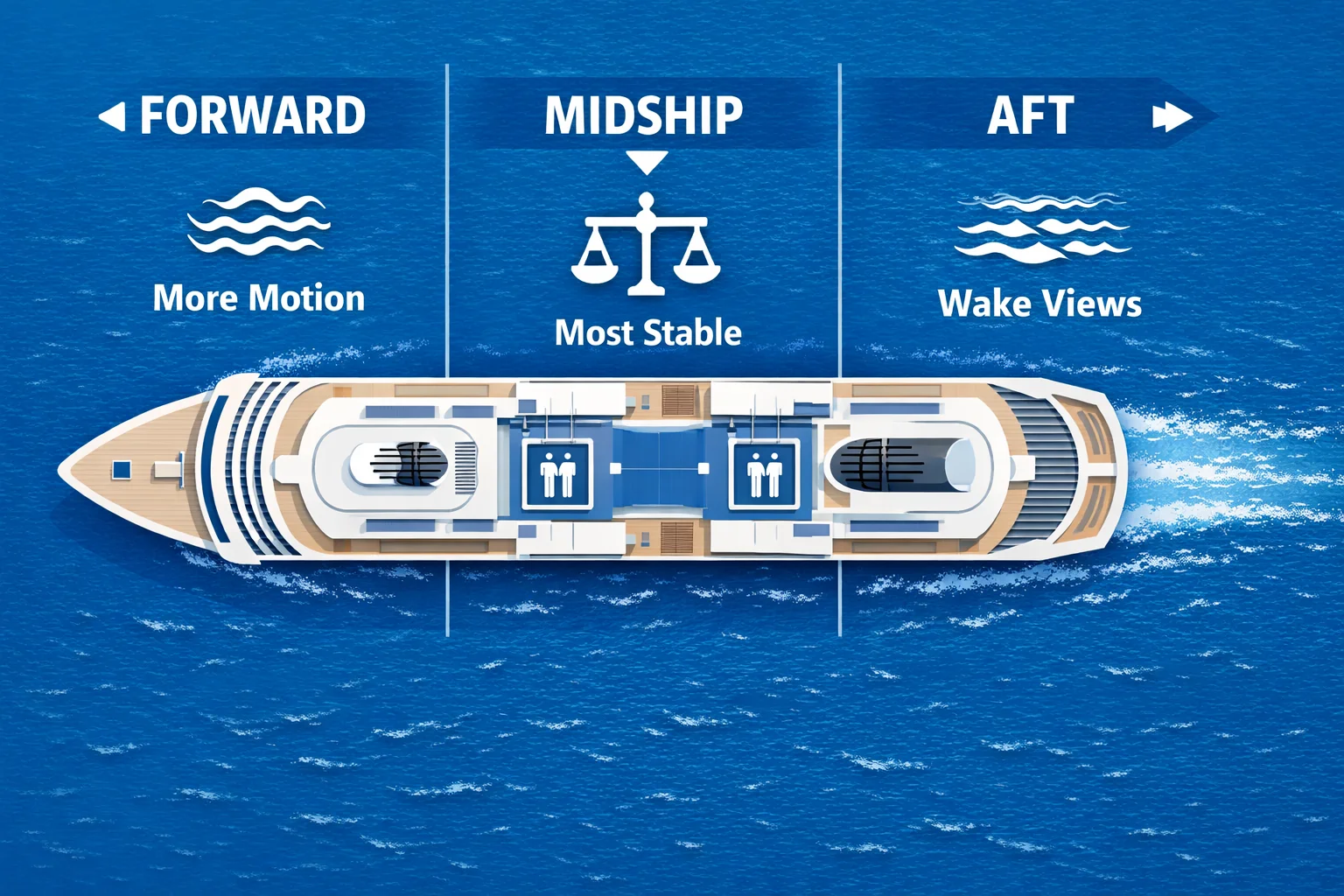
Forward vs Midship vs Aft Cabins on MSC Cruises
Once you understand deck placement, the next big decision is where you want to be from front to back.
Forward cabins
Forward cabins sit toward the front of the ship.
These can be appealing for a few reasons. Hallways in forward sections often feel quieter than busy midship areas, especially if you are not right next to a major public venue. On many ships, forward cabins may also put you closer to the theater, spa, or certain lounges.
The tradeoff is motion.
If the ship hits rougher seas, forward cabins are where you are more likely to feel the ship “pitching” up and down. Some cruisers barely notice it. Others absolutely do.
Forward cabins can be a good fit for:
- cruisers who are not especially motion-sensitive
- guests who like quieter-feeling hallways
- travelers who use forward venues often, like the spa or theater
Forward cabins may be less ideal for:
- first-time cruisers worried about seasickness
- anyone who wants the most stable part of the ship
Midship cabins
Midship cabins are in the center of the ship, and for most travelers, this is the safest all-around recommendation.
This is typically the most stable part of the ship, which makes midship especially popular with first-time cruisers and anyone concerned about motion sickness. It is also a practical location because it gives you easier access to both ends of the ship rather than locking you into long walks every time you want to get somewhere.
That does not mean midship is perfect. Midship areas are often in high demand, and if you are too close to the elevator banks, you may get more hallway traffic than you would farther out.
Still, if someone asked for the simplest answer to “Where should I book my cabin on an MSC cruise?” midship would usually be it.
Midship cabins are a good fit for:
- first-time MSC cruisers
- motion-sensitive travelers
- guests who want the most balanced location on the ship
Aft cabins
Aft cabins are at the back of the ship, and they tend to have a loyal fan club.
Why? The views.
Aft-facing cabins can offer those beautiful wake views where you watch the ship’s trail stretching across the water. On some ships and in some cabin categories, aft balconies can also feel roomier or more dramatic than a standard side-facing balcony.
That said, aft cabins are not automatically better. Depending on the ship and deck, you may notice engine vibration, mechanical noise, or thruster sounds during docking. They can also mean longer walks to forward venues like the theater or spa.
For some cruisers, that is a small price to pay for the scenery. For others, it gets old quickly.
Aft cabins are a good fit for:
- cruisers who love wake views
- guests who do not mind extra walking
- travelers who want a less central location
So Which Is Best: Forward, Midship, or Aft?
There is no single right answer for every cruiser, but here is the practical breakdown:
- Choose midship if you want the least motion and the easiest all-around recommendation.
- Choose forward if you like a quieter-feeling area and are not worried about extra motion.
- Choose aft if views matter most and you do not mind a longer walk.
If you are torn and just want the safest pick, go midship.
Near the Elevators or Far Away?
This is one of the biggest tradeoffs in cabin location, and it matters more on MSC than some people realize because many of the ships are large enough that the walking really adds up.
The case for staying near the elevators
Being near the elevators can make your cruise noticeably easier.
This is especially true for:
- families with kids or strollers
- travelers with mobility concerns
- guests who return to the cabin often
- anyone sailing on a big ship like those in the Meraviglia or World Class
A cabin near the elevators makes it easier to get to the pool, buffet, dining, theater, and back to your room without turning every errand into a mini hike. Over the course of a week, that can save a lot of steps and a surprising amount of time.
The case for staying farther away
The downside of elevator proximity is noise.
Elevator banks tend to be high-traffic areas. You may hear more hallway chatter, more doors opening and closing, and more late-night voices from people heading back to their cabins after dinner, drinks, or shows.
If quiet matters most, a cabin farther down the hallway is often the better choice.
In fact, cabins at the very end of long corridors can be some of the quietest on the ship because there is almost no pass-through foot traffic. If nobody needs to walk past your room to get anywhere else, that can make a real difference.
The honest answer
This one comes down to your priorities.
A lot of cruisers think they want the quietest room possible, until they are making that long walk several times a day. Others gladly accept the extra steps because they value sleep more than convenience.
There is not a wrong answer here. Just make sure you are choosing the tradeoff you actually want.
When we cruise, we like to stay close to the rear elevator and stairs bay for each access, but not so close that the hallway noise will enter our cabin. We usually pick a room 10-20 cabins away from these elevators. On some ships, like the Meraviglia and Seaside classes, there is also another, less used elevator in this area as an extra bonus!
The Cabin Location Red Flags to Avoid
If you want the best cabin location on an MSC cruise, sometimes the smartest move is not chasing the “perfect” cabin. It is simply avoiding the problem cabins.
Here are some of the biggest red flags.
Directly under the galley
This is one of those cruise cabin mistakes that can sneak up on people.
Galleys can create dragging, rolling, and banging noises late at night or early in the morning. It may not look obvious on the deck plan, but you can absolutely hear the difference if your room is in the wrong spot.
Directly under the pool deck
If you have ever heard deck chairs scraping across a deck at sunrise, you already know why this matters.
Rooms under the pool deck can pick up chair movement, foot traffic, setup noise, and general early-morning commotion.
Over a nightclub, lounge, or busy entertainment venue
Bass travels. Sometimes very well.
A room above or below a nightlife venue can mean thumping vibrations and late-night noise long after you were hoping to be asleep.
Near major public spaces
Even if your cabin is not directly above or below a loud venue, being close to a busy staircase, service area, or gathering point can still bring more traffic and noise than you expected.
This is why checking the deck plan matters so much. You are not just booking a room. You are booking everything around it too.
MSC-Specific Cabin Location Tips
MSC has a few ship features that make cabin location especially important.
Yacht Club cabins are usually forward and high up
If you are booking MSC Yacht Club, you are usually choosing a private, exclusive section of the ship that is positioned forward and higher up.
That location is part of the Yacht Club experience. It is designed around privacy, premium spaces, and separation from the rest of the ship, not around classic midship stability.
For many Yacht Club guests, that tradeoff is absolutely worth it. But it is still worth understanding if you are highly sensitive to motion.
Aurea guests should think about access, not just the room itself
If you are booking Aurea, it is smart to think beyond the cabin and consider how close you are to the areas you may use most, especially the spa and top-deck adults-only spaces.
You do not need to obsess over exact placement, but convenience can be part of the value here.
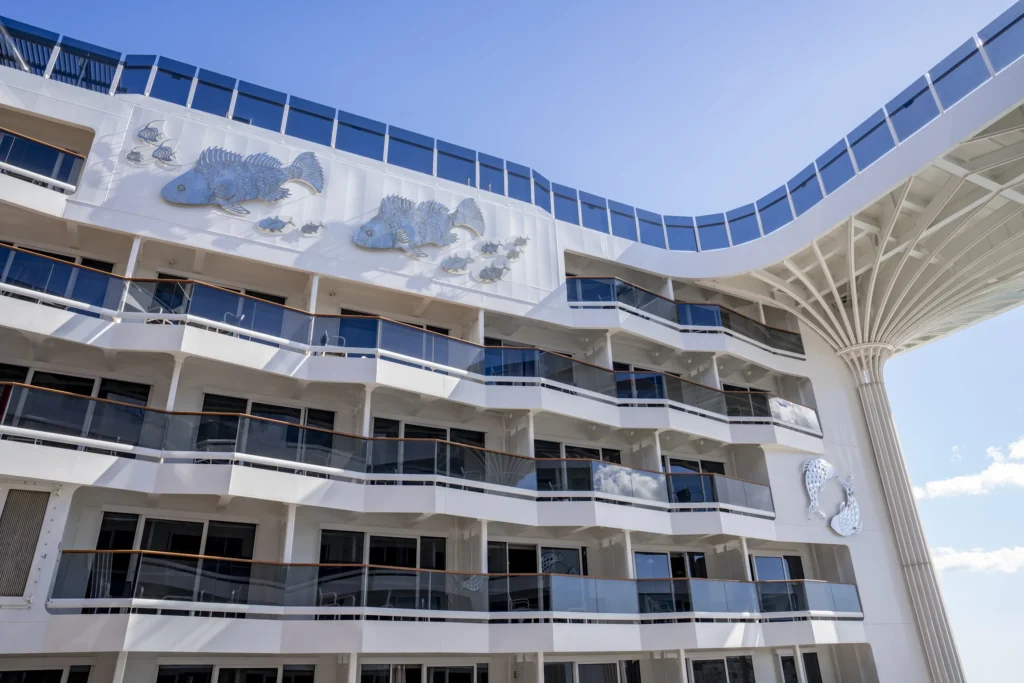
Some World Class balconies are promenade-facing, not ocean-facing
This is an important one because it can catch people off guard.
On some World Class ships, certain balconies face inward toward the ship’s central promenade rather than outward toward the ocean.
That means the difference is exactly what it sounds like:
- Ocean-facing balcony = your balcony looks out over the sea
- Promenade-facing balcony = your balcony looks inward at the ship’s open interior promenade area
Promenade-facing balconies can actually be fun for some travelers. They offer people-watching, a different atmosphere, and a more lively feel. But they are also less private and do not deliver that classic ocean-view balcony experience many cruisers picture when they book.
So if an ocean view matters to you, read the cabin description carefully and do not assume every balcony faces the water.
Best MSC Cabin Location by Traveler Type
If you still are not sure where to book, here is the simplest way to think about it.
Best cabin location for first-time MSC cruisers
- midship
- not directly next to the elevators
- cabins above and below if possible
This is the safest, easiest, least-regret option for most people.
Best cabin location for motion-sensitive cruisers
- lower deck
- midship
- avoid far forward and very high decks
This is the closest thing to a motion-minimizing setup.
Best cabin location for couples who want quiet
- farther down the hallway
- away from elevators
- avoid rooms under pool decks, galleys, and nightlife venues
Best cabin location for families
- near elevators can be worth it
- convenience often matters more than having the quietest hallway
- connecting cabins may matter more than perfect ship position
Best cabin location for view lovers
- aft-facing cabins can be especially appealing
- ocean-facing balconies matter if you want that traditional cruise view
- be careful not to confuse promenade-facing with ocean-facing on applicable ships
Final Thoughts
The best cabin location on an MSC cruise is not the same for everyone.
Some cruisers want the smoothest ride possible. Some want wake views. Some want to be close to the elevators. Some just want a quiet room where nobody is dragging deck chairs over their head at dawn.
That is why the smartest way to choose a cabin is to stop looking for the one “best” location and start looking for the best fit for your priorities.
For most travelers, a midship cabin with cabins above and below it is the safest all-around recommendation. But forward and aft can absolutely be the better choice for the right cruiser.
The key is simple: study the deck plan, understand the tradeoffs, and pick the location that matches how you actually cruise.